| |
|
What future for the domestic food aid in the United States?
Momagri Editorial Board
January 23, 2017
While the elimination of Obama Care was one of President Trump’s first decisions, will one of the other pillars of the American social policy and the fight against poverty––the domestic food aid––meet the same fate?
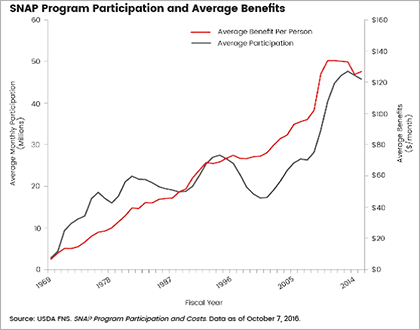
The key program to fight hunger is the Supplemental Nutrition Assistance Program (SNAP) that provides food stamps to the poorest people at a marginal price based on their incomes. Extended to families with a monthly income lower than 130% of the poverty threshold, a recent USDA report published by the House of Representatives1 indicates that a total of 43.4 million Americans gained from the program in 2015 for an average monthly amount of $120, as shown by the graph below.
Historically, the domestic food aid programs are discussed in the agricultural finance law––the Farm Bill––even if the proportion of in-kind support has been declining since the reintroduction of the food stamps in the early 1960s.
The Child Nutrition Programs, the Special Supplemental Nutrition Program for Women, Infants and Children (WIC) and the National School Lunch Program2 were taken out of the Farm Bill’s Nutrition Title. Since 2012, they are managed by the commission in charge of agricultural issues, the education committees and the Senate. In addition to the SNAP, the Nutrition Title includes seven other programs for a budget of $1.2 billion in 2016. One of its main program is the $663.5 million Emergency Food Assistance Program (TEFAP) managed by the Department of Agriculture, which is in charge of purchasing agricultural surpluses and allocating them between the food banks and clinics in the states and the federal district.
During the negotiation of the latest Farm Bill, the withdrawal of the nutrition issue from the Farm Bill was widely discussed and promoted not only by the denigrators of the SNAP but also by some of its proponents who feel that the food aid programs are benefiting from an adequately robust budget to exist by themselves. Today, this possibility seems unlikely in the next reform, since the House of Representatives itself recognized it in its latest report on the SNAP.
Ultimately, whether the food aid budgets are discussed or not in the framework of the Farm Bill is less significant than the amounts allocated. The context of declining agricultural prices could also be instrumental, as it was the case in the past. Sophie Devienne brings this to light by writing that in-kind programs are more used in periods of low agricultural prices in her very comprehensive article3 published in the 2012 Demeter.
Beyond Obama Care, social assistance in the United States includes important federal programs known as Welfare Programs, which provide financial assistance and services to low-income people through 153 programs linked to the Department of Health and Human Services4. As a result, the US food assistance programs must be considered as an additional but not substitutable element to social aid programs. Consequently, as promoted by Momagri since its first research work and publications on the American support policy to agriculture, the US food aid also constitutes a support to the disposal of agricultural and food products. This is self-evident, since it would be useless to deny the impact on supply of a program stimulating demand. According to Sophie Devienne, “American agriculture should therefore still rely on the support of the agricultural policy in the next few years. But is it not one of the prime objectives of an agricultural policy to ensure the food security of the population?”
Since we know that 93% of the food consumed in the United States comes from the American agricultural food production, we must consider the same proportion of the food assistance budget as equivalent of support to the agro-food sector. Such thinking is one of the principles of the SGPAA (Soutiens Globaux à la Production Agricoles et Alimentaires) indicator designed by Momagri, whose aim is to determine the amounts of direct and indirect support to agriculture and food. As a reminder, the total amount of the US domestic food aid reached $103 billion in 2013.
1 http://agriculture.house.gov/uploadedfiles/snap_report_2016.pdf
2 https://www.nwica.org/blog/weekly-wic-policy-update-61#.WKxo-vJK5ME
3 http://www.clubdemeter.com/(…)/la_politique_alimentaire_des_etats_unis_premier_poste_de_depenses_(…).pdf
4 https://www.cfda.gov/ There are 2306 programs in the Domestic Assistance Catalog.
|
|
| |
| | | |
| | |
| |


